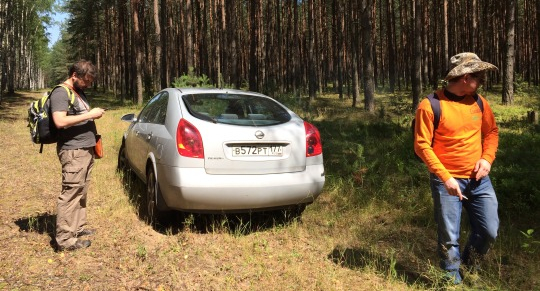
A lovely warm day in the forest, about 20 miles south of Vilnius toward the border with Belarus. Dima — a Russian former newspaper editor who lives here, and whose acquaintance I owe to the inestimable John Pancake — his friend Mischa, my American friend Ellen (who instigated my coming here in the first place) and I were there to hunt for chanterelles, which are supposed to be plentiful this time of year.
Supposed to be. We drove until the dirt roads neared impassibility for Dima’s Volvo, then hiked over spongy moss into the pine and birch woods, looking for what the Lithuanians call grybas – edible mushrooms.
Dima, who grew up in Siberia and knows his forests, told us we had to be careful to keep track of our direction and distance, since there were few landmarks; just miles of trees in all directions.
For history buffs, this was near the Rudnicki forest, one of the areas where Jewish partisans hid and harrassed the Germans after escaping the Vilna Ghetto. It was sobering to think about what it must have felt like, trekking through these woods with the understanding that any chance encounter could be fatal.
Today the woods were indeed full of edibles – wild blueberries and raspberries, and even cranberries. But the only mushrooms we found were inedible, what Dima referred to as paganti — not chanterelles.
Wild blueberries
A nonedible mushroom.
Something that is not a mushroom.
 ACassel's Pages