
The Wall St. Journal has a laudatory profile of the head surgeon at New York City’s Columbia-Presbyterian Hospital, whom the headline terms “The Pandemic’s Most Powerful Writer.”
Dr. Craig Smith sits down at his computer each day in a hospital under siege and starts typing.
His note to the Columbia University department of surgery on the evening of March 20 began with the latest, grimmest statistics from the coronavirus pandemic: the positive tests, the disappearing beds, masks and ventilators, the curve too stubborn to bend. It was an email that would’ve been crushing if he’d stopped there. He didn’t.
“So what can we do?” Smith continued. “Load the sled, check the traces, feed Balto, and mush on. Our cargo must reach Nome. Remember that our families, friends, and neighbors are scared, idle, out of work, and feel impotent. Anyone working in health care still enjoys the rapture of action. It’s a privilege! We mush on.”
That last paragraph about a dog sled racing to beat another epidemic nearly a century ago is the reason his colleagues are no longer his only readers. The daily notes of this 71-year-old surgeon, which are now published on Columbia’s website and shared widely on social media, have become essential dispatches for many people in search of leadership, courage and maybe even a pep talk. Dr. Smith’s emails are Winston Churchill’s radio speeches of this war.
The piece triggered a powerful memory for me. In June, 1999, my dad, then aged 79, was in Columbia-Presbyterian, being operated on for a life-threatening condition called aortic stenosis. Essentially, one of his heart valves was no longer functioning.
My sister Robin and I had taken him in the previous day, and had been in his room when he met with a cardiologist, who explained his condition and told us that a Dr. Smith – whom we hadn’t met – would be operating on him.
That morning, we walked with him to the OR, held his hand and kissed him, trying to project less worry than we felt. He was doing the same, but the fear in his eyes was obvious.
Told it would be several hours before there was news, we headed to the hospital cafeteria for coffee. An attractive nurse got on the elevator with us, and empathetically asked what we were there for. A heart operation. Who? Our father.
“Who’s doing the surgery?”
“Dr. Smith.”
Her eyes became dreamy. “Oh,” she said. “Dr. Golden Hands. He’s the best.”
Later, we sat in a waiting room filled with anxious people. Directly facing us, a woman in a scarf fingered rosary beads with a crucifix, next to a black-hatted Hasid who rocked back and forth reciting psalms. It was a long morning. 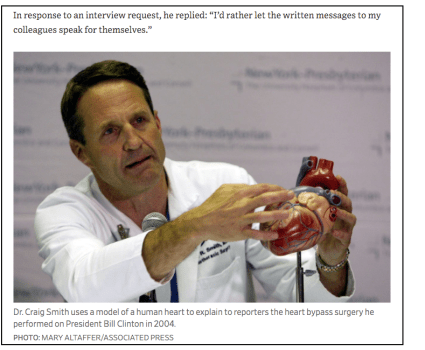
Suddenly, we were summoned into a side room, where after a moment, Robert Redford’s double appeared, in a surgical gown. It was Dr. Smith. In less than 10 minutes, he succinctly explained that the surgery had gone fine, no complications. My dad had a new aortic valve, made of “animal tissue.” (They commonly use pig valves, but downplay the source to spare the sensibilities of Jews and Muslims, I suppose.) The old valve, Dr. Smith said, had almost certainly been malformed from birth, with two of its three leaves, which open and close on each heartbeat, fused together. As my father aged, this problem grew more acute, finally threatening his life. (The new valve gave him another 16, mostly very good, years.)
That short conversation has stayed clear in my memory, for two reasons. First because the facts were so important – I and my daughter have both likely inherited a version of my dad’s congenital valve condition, based on our record of minor heart murmurs. But second, because the person giving us the information was so remarkably clear, concise and straightforward.
Just like the memos he’s been sending to the Columbia-Presbyterian staff.
 ACassel's Pages
Leave a comment