Vanguard looks to a future without John Bogle
The Philadelphia Inquirer Magazine
Sunday, January 14, 1996
By ANDREW CASSEL
Staff writer in The Inquirer’s business news department.
OUTSIDE THE ST. REGIS SHERATON, the spring sun was bright and the Midtown Manhattan streets were jammed. Inside a small conference room on the second floor, reporters gathered from the nation’s business press, from the New York Times to USA Today, from Institutional Investor to the Wall Street Journal, to record a pivotal event in the life of one of the country’s most important financial institutions. The focus of their attention had driven up the night before from Haverford in a plain black Lexus sedan. The elegant St. Regis wasn’t exactly his style; before checking in, he had persuaded a desk clerk to reduce the room rate by $40.
Now Jack Bogle stood outside the oak-and-crystal conference room, greeting many of the reporters by name. You couldn’t say he looked well – his frame lacked its former Marine-like leanness, his face was puffy, and he seemed short of breath, the result of heart problems that had dogged him for 35 years. But his gaze was steady as he sat down at the head of a long table and summed up a life’s work.
“Twenty years have now passed since a fledgling organization that I named Vanguard entered the mutual-fund industry,” he said. “We have since become the second-largest mutual-fund complex in the world. Just last week our assets crossed $150 billion, a 100-fold increase from where we began in 1974.”
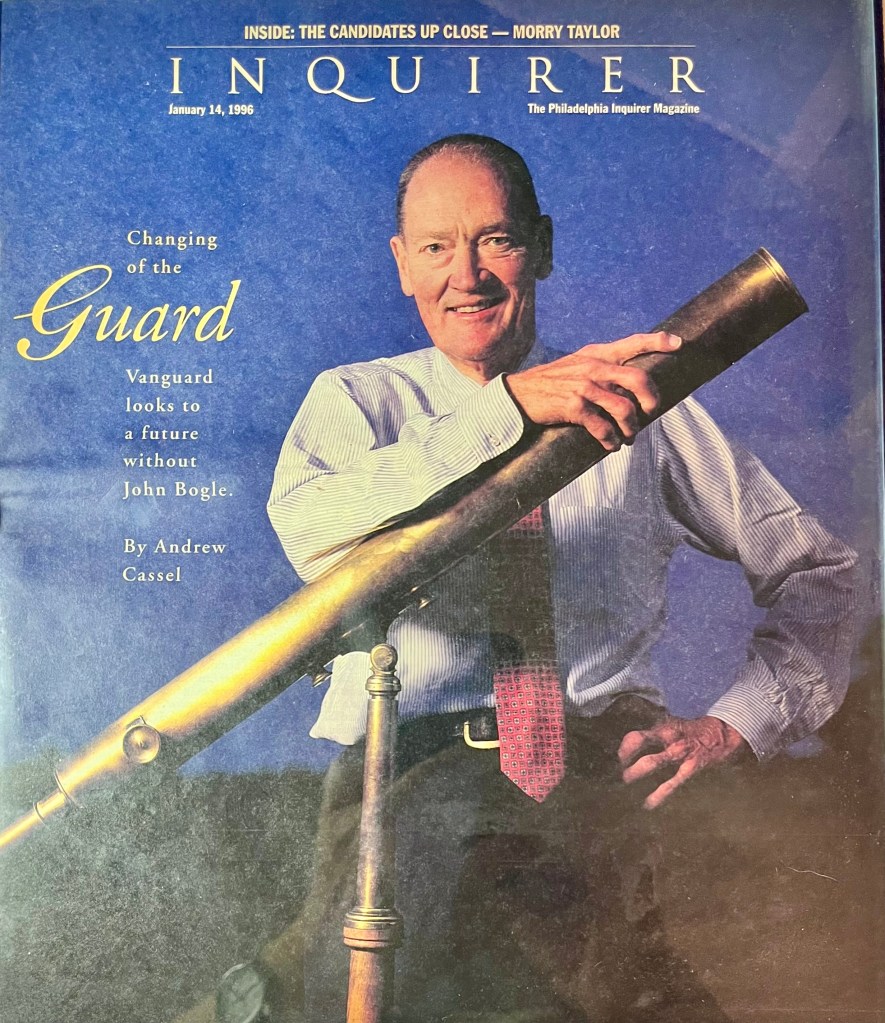
The organization that he had founded partly to prove an academic point had risen from nowhere to the top ranks of a new financial order, in which Americans no longer automatically entrusted their savings to banks and their investments to stockbrokers. If the revolution that overhauled American personal finance had had a Declaration of Independence, Jack Bogle might have been its John Hancock —not the only author, but the one with the biggest signature on the document.
In the past two decades, it had become almost a cliche to call Jack Bogle the mutual-fund industry’s conscience. When he spoke, his competitors listened, the regulators listened, the media and the investing public listened. When he called the fees charged by most mutual funds unconscionably high; when he denounced fund operators for questionable advertising; when he warned investors that trying to beat the stock market was a fool’s goal, people paid attention.
By the end of 1995, Vanguard held assets of nearly $180 billion —a number that grew as the stock market continued to climb – and some 4 million American households turned over an additional $2 billion of their savings to the company every month. It had become the largest financial institution in the Philadelphia area, dwarfing the region’s banks and insurance companies. No other organization in this region oversaw so many people’s money, or so much, and none had as broad an influence as Vanguard on the savings and investment habits of the nation.
And now, Bogle told the assembled reporters, he was passing the baton.
*
IN THE BEGINNING was the Word.
It was 127 pages long, typed and double-spaced, with footnotes and bibliography, and carried the prosaic title “The Economic Role of the Investment Companу.” Submitted by John C. Bogle to Princeton University’s Economics Department as a senior thesis in 1951, it was dry, thorough and scholarly.
“The tremendous growth potentiality for the investment company … rests on its ability to serve the needs of both individual and institutional investors,” Bogle the undergraduate wrote. “It can do this best by stating its objectives explicitly, so that a minimum of investor misconception as to the fundamentals of equity will exist.”
It was only later that it became clear this was no mere ticket to a baccalaureate degree. More on the order of a lifetime blueprint. Or the Gospel According to Jack.
Mutual funds, Bogle wrote, could be ideal savings vehicles for average Americans, giving them the benefits — diversified investments, low transaction costs, etc. — that historically had been enjoyed only by the very rich.
But Bogle noticed several problems with the fledgling industry. “Funds can make no claim to superiority over the market averages,” he wrote. Furthermore, “there is some indication that the cost of management is too high.”
Worse, there was the advertising. Bogle disliked it instantly. “The funds and their distributors have incurred large expense by the publication of elaborate brochures and sales literature. This expense is paid for, in effect, by the shareholders. . .”
Bogle’s thesis landed him a job after graduation with Walter Morgan, a patrician Philadelphian who had started one of the first modern mutual funds in America. The Wellington Fund had opened for business in 1929, just three months before the Great Crash; it survived in part because of Morgan’s belief in balancing “aggressive” stock holdings with “defensive” investments in bonds. By 1951 it was one of the largest mutual funds, with more than $100 million in assets.
But within Philadelphia’s financial community of those years – a tight club clustered within a few blocks of 15th and Walnut Streets – mutual funds were considered poor cousins. The top money managers worked for banks and insurance companies, overseeing great pools of wealth accumulated by wealthy families, church and university endowments or pension funds. You could make a few decisions, discuss them with the client over lunch and be at the Racquet Club for drinks by 5 p.m.
The stereotypical Wellington investor, on the other hand, was a widow or retired couple with a few thousand dollars. Mutual-fund managers did much more clerical and accounting work, processing statements and hustling for sales through armies of commissioned sales brokers.
“It was a small cottage industry back in 1951,” Bogle recalled recently. Not like the city’s banks, which were rock-solid and prestigious. Philadelphia National, Girard, Provident and PSFS were names engraved in granite; they were places where a crew-cut Ivy Leaguer in the era of The Organization Man could look forward to a lifetime career. Even Bogle joined Wellington only after he “thought long and hard about going to work for the Philadelphia National Bank in their credit-training program, which I thought was more secure.”
Raised in a once-affluent New Jersey family that had lost much of its wealth during the Depression, Bogle nonetheless moved easily into Philadelphia’s inner financial circles. In 1957 he married Eve Sherrerd, whose father was a partner in one of the city’s leading brokerage firms, Butcher & Sherrerd. Saturdays he met Paul Miller, a principal in Drexel & Co., for a 7 a.m. golf outing at the Merion West course, walking the 18-hole course sans caddies in 2 1⁄4 hours. “We both walked fast,” Miller recalls.
The prosperous, stable 1950s were good for mutual funds; the booming 1960s were even better. But as Wall Street entered its “go-go” years, the conservative Welington Fund began to look increasingly stodgy. In Boston, the nation’s leading money-management city, a Fidelity manager named Gerry Tsai was racking up huge gains by “swinging” in and out of hot growth stocks. For the first time, the media began keeping score of mutual-fund managers’ performance, and the public flocked to those with the highest rankings.
Bogle, by then a top Wellington executive, may have been conservative in his soul, but he was competitive in his bones. He moved aggressively to shore up Wellington’s flagging position, merging in 1967 with a Boston firm called Thorndike, Doran, Paine & Lewis, that had run up an impressive record managing a hot-stock fund.
The merger would go down as one of the most momentous failures in modern financial history. It soured on almost every level. Bogle was devoted to building the mutual-fund group; Thorndike Doran was principally an investment adviser for the rich and for institutions, and saw mutual funds as a sideline. Bogle wanted to consolidate the firm in Philadelphia; his partners clung tenaciously to Back Bay. Even their personal styles clashed. “Jack was Philadelphia — red challis ties and button-down collars. He still wore his brown hat and rode the train in from the Main Line,” remembers Jim Riepe, a close Bogle aide in those years. The Bostonians wore power ties and suspenders and took taxis and limousines. “Philadelphia just didn’t create those Wall Street types,” Riepe said, “and the Boston guys had a lot of that.”
The fissures became chasms as the go-go years came to a screeching halt. By the early 1970s, the United States was beginning a cycle of inflation and stagnation that sent investors fleeing the stock market in all forms. The Dow Jones Industrial Average fell 30 percent from 1968 to 1970, rose again, then fell almost 40 percent from 1972 to 1974 in the worst bear market since the Depression.
To understand what happened next at Wellington, you need to know a bit about how mutual funds are organized. Under the law, a fund is an independent “investment company” owned by its shareholders, who elect a board of directors to choose the portfolio managers, accountants, mail clerks and so on.
In reality, almost all mutual funds are controlled by their investment advisers. A management company, which is what Wellington was, organizes the fund and then sells it its services, taking a percentage of the fund’s total assets in fees. Bogle at the time served as chief executive officer both of Wellington Management Co. and of its eight mutual funds, including both the original Wellington Fund and the Windsor Fund, which had started in 1958. But the largest chunk of Wellington Management Co. was owned by the Boston partners, who controlled a majority on its board of directors. By early 1974, moreover, the Bostonians had had enough of what they considered Bogle’s recalcitrance and self-righteous hectoring. They demanded his resignation. When he refused, they fired him.
*
BEING FIRED FROM WELLINGTON, Bogle wrote years later, left him “heartbroken, my career in shambles, and what I had considered ‘my’ company controlled by others.”
But he didn’t just go away. Instead, Bogle turned to the independent directors of the mutual funds themselves, who voted to keep him on as their chief executive officer.
At first it was a little like being president for paper clips — he was responsible for routine paperwork, shareholder newsletters and legal matters — but it also freed Bogle to plan a completely new and original strategy. At his urging, the Welington funds gradually declared their independence from their investment managers. To handle sales, distribution and administration, they created a new organization of their own: The Vanguard Group. Bogle named it for British Admiral Horatio Nelson’s flagship, with which he beat Napoleons’ navy in 1798. The funds also became “no-load,” chucking their network of commissioned sales people in favor of direct-mail and telephone sales.
The industry had never seen anything like it before, and hasn’t since. Through Bogle’s coup, Vanguard became the only “mutualized” mutual-fund company, legally similar to a mutual savings bank or insurance company. Under Vanguard’s corporate structure, its mutual-fund shareholders own the funds, and the funds own the company. Vanguard itself earns no profits, charging the funds only what it costs to provide investment management and administration. To appreciate this, consider for a moment how selling mutual funds differs from most other ways of making a living.
If your business is cars or law or peanut butter, you have to find a customer, make a sale and do it all over again next year. If you do good work, you can hope customers will come back when they need another car or more advice or when they run out of peanut butter. But to pay the rent and maybe even grow the business, meanwhile, you have to be out there hunting up more customers, essentialy all the time.
If you manage assets such as mutal funds, on the other hand, every “sale” creates a revenue stream that continues aw long as those assets stay in place. For watching over the shareholders’ dollars, fund managers get to clip a few pennies for themselves, every year, forever — or until the customer makes a conscious decision to take those assets elsewhere.
Moreover, if things go OK next year and the markets have grown at their average historical rate of about 10 percent, the fund company can factor that growth right in. Without making a single additional sale — voila!- 10 percent revenue growth. And that’s before including automatic investment plans such as IRAs or 401(k)s, which funnel in new cash continually through payroll deductions and annual contributions.
Combine all that with a guarantee that the fund company’s product will be mentioned in hundreds of newspapers overy day — sure, the type is small, but it’s free — and you can understand why the number of mutual funds has exploded from around 500 in 1975 to more than 5,300 today.
Americans have entrusted more than $2 trillion to mutual funds — more than to savings banks, insurance companies or credit unions — and have done very well on the whole. But the owners of fund companies themselves have done much, much better, turning those pennies and nickels into some of the largest personal fortunes in America.
Ned Johnson, whose family controls the $330 billion Fidelity mutual-fund group — the nation’s largest — is a multibillionaire. John Templeton, who sold his own fund company in 1992 for $913 million, gives $10 milion away each year through his Radnor-based foundation. In 1994, Smart Money magazine added up the estimated net worth of 10 top fund executives and came up with $8.5 billion. Clipping pennies from other people’s money adds up — especially when the stock market, demographics and the U.S. tax code are all on your side.
Jack Bogle’s Vanguard Group clips pennies from its mutual funds, too, lots of them. But look at any mutual-fund listing that compares the funds’ expense ratios – the percentage of assets that the management takes in fees. (The Inquirer’s business news section lists them in the mutual-fund tables every Thursday). According to Lipper Analytical Services, which tracks mutual funds, the average common-stock fund takes about $1.47 of every $100 invested for expenses each year. Include bond and money-market funds, which are cheaper to run, and the average drops to 96 cents. Vanguard’s average expense ratio is 30 cents per $100, or less than a third of that average. No other fund group even comes close.
That gap, which nobody in the mutual-fund business disputes, is the single most important fact about Vanguard, defining the company outside and in. Company executives contend that it translates into about $1 billion each year that Vanguard customers don’t pay, compared with their counterparts at other fund companies.
Vanguard’s low-cost strategy not only gives the company its main marketing edge, generating reams of favorable coverage in newspapers and magazines popular with investors, but has also shaped its corporate culture, management structure and even the physical layout of its offices.
Since 1993, Vanguard’s home has consisted of six almost featureless brick buildings next to a steel mill alongside Route 202 in Tredyfirin Township, Chester County. The place boasts all the architectural elegance of a suburban community college. The chief decorative elements are a plain, square, eight-story bell tower and a free-standing weathervane in the shape of a British frigate — the HMS Vanguard.
The nautical theme pervades; each building is named for another of Nelson’s ships, so that visitors might be directed to see Mr. Smith in Audacious, or Ms. Jones in Goliath. Bogle and Vanguard president Jack Brennan, along with a few senior managers, inhabit Victory.
The real theme, however, is a kind of monastic egalitarianism. Most managers work out of small, windowless office cubicles; windows are reserved for the “crew” — as the nearly 4,000 employees are called, including the 700 or so assigned to answering about 25,000 telephone calls a day from shareholders. (Hundreds more, including top executives, can be switched to phone duty on heavy days or when the stock market coughs.)
A running office joke is that they use drip coffeemakers because Bogle is so opposed to perks. A true fact is that the mahogany table in Vanguard’s boardroom doesn’t match the room’s oak paneling; when the company moved its headquarters in 1993, Bogle decided the old table was good enough. Although “spartan” would be going too far, the 200-acre campus doesn’t rise much above the corporate-functional. From the chairman on down, everyone parks in the same lot and lunches in the same company cafeteria. There are no executive bathrooms.
Titles are temporary and elusive (one supervisor last year was introduced to a caller as an “agenda champion” and becoming more so; one of incoming CEO Brennan’s first moves was to level all but a handful of official designations, so that managers, now known only as “principals,” can be shifted about more flexibly. “It takes a little hierarchy out of the organization,” Brennan said recently.
Brennan, a 42-year-old banker’s son from suburban Boston, was working at Johnson’s Wax near Chicago in 1982 when Bogle, then in the market for an assistant, found his name on a list of Harvard MBAs. When someone proposed flying the candidate in for an interview, Bogle was aghast: “I said, Do you know how much it costs to fly from Chicago to Philadelphia? Call him on the phone!”
Whether or not such stories are amplified as part of the Vanguard image-building process, they are legion. After a conference on the Wharton School’s West Philadelphia campus one snowy day, recalls finance professor Jeremy Siegel, he offered to find Bogle a taxi. “Isn’t there a bus stop around here somewhere?” the Vanguard executive replied. Less talked about, but perhaps closer to the core, is Bogle’s competitiveness and determination. His first heart attack came when he was 30. At 37, his doctor was warning him he would have to retire. He changed doctors. He out-lived three pacemakers and suffered cardiac arrests on at least five occasions — one was on a squash court — and was saved, as he put it, “thanks to a passerby or a guy hammering on my heart.”
His ailment, known as right ventricular dysplasia, was a congenital electrical defect whose only known cure is a transplant. He nonetheless continued to work a regular schedule and kept a gym bag with a squash racquet open by his office desk as late as 1993.
At home in Haverford, the Bogle family lived comfortably but unostentatiously; there were no servants, but his two sons and four daughters all attended the private Haverford and Shipley Schools. John Bogle Jr., now a portfolio manager in Cambridge, Mass., recalls a house where the thermostats were set low and children were taught money fundamentals early. “ ’Mind your pennies and the dollars will take care of themselves’ — I heard that at a very early age,” he said.
In the 1940s, despite his own family’s straitened circumstances, Bogle and his two brothers had attended Blair Academy, a traditional private school in northwestern New Jersey. Jack Bogle would later credit the school, which sent him on to Princeton with a ful scholarship, for much of his success. As chair of Blair’s board of trustees he has returned the favor; the school now boasts a $1 million Bogle-endowed scholarship fund and a $3.5 million math-science building called Bogle Hall. A new $7 million performing arts center, to be named for Bogle’s grandparents, is under construction. “It’s not so much frugality as fairness that really matters to him,” observes Blair’s headmaster, T. Chandler Hardwick, whom Bogle personally recruited to run the school in 1989. Then a prep-school teacher with no administrative experience, Hardwick recalls how Bogle offered him the job after just one lengthy interview: “He said, ‘I believe you’ll be honest with me. The most important trait to me is integrity; if you exhibit that, we’ll stick with you as you make mistakes.’ And that’s been true.”
*
VANGUARD TODAY is the word – Bogle’s 1951 Princeton thesis — made flesh. In the design and management of its funds, as well as the kind of marketing it does and does not do, the company takes its direction from its founder’s principles.
First among these: No hard sell. Bogle retains an almost Victorian dislike of advertising, refusing to spend more than about $5 million a year – Fidelity spends close to $100 million — on advertising. The few newspaper and magazine ads he places are notable for what they never do, which is to brag about the performance of a Vanguard mutual fund.
“We don’t use the word product, because we think it cheapens the mutual-fund idea,” Bogle said recently. “The only thing worse than a ‘product’ is a ‘hot new product.’” Particularly appalling in Bogle’s view are ads that tout a particular fund’s performance, showing through charts or numbers that the XYZ Growth Fund was Number One in its class for the past year, or three years, or whatever.
Such ads invariably also carry some tiny type at the bottom, which says something like: “Past performance is not indicative of future results.” Most people, if they read it at all, probably conclude that it’s some sort of legal requirement – which it is — and jump right back to those juicy-looking investment results.
The problem is, Bogle insists, it’s also literally the truth. Even if a particular mutual fund really does outperform its peers in a given year – and fund companies have been known to base such claims on fairly well-cooked numbers – the chances it will continue to lead the pack over the long haul are slim. Investors, moreover, are much more likely to lose money chasing highly touted “hot” funds than not, for two reasons: 1) They’re buying in after the fund has hit it big, not before (the idea, remember, is to buy low and sell high), and 2) funds that pay for superstar managers and big-time marketing campaigns pass those costs back to their investors via high fees. The fund manager touted by your stockbroker or your brother-in-law as the next Wall Street genius may or may not be one, but you’ll pay up front to find out.
Not that some portfolio managers don’t do extraordinarily well. Even Bogle admits there are legitimate superstars out there, people such as Warren Buffett, Peter Lynch or even John Neff, who ran Vanguard’s own Windsor Fund for 31 years until his retirement last month. Under Neff’s guidance, Windsor Fund ran up a whopping average annual gain of 13.85 percent — almost 30 percent better than the overall market — which means that $1,000 invested in the fund when he started in 1964 would be worth almost $59,000 today.
It’s just that there can’t be more than a very few Neffs, Buffets and or Lynches out there, Bogle argues. Not just that there aren’t, but that there can’t be. “For each guy that’s so brilliant he adds 10 percent annually to the return, it is in the nature of the system that there’s somebody else out there who’s going to lose 10 percent,” Bogle said.
The alternative for investors is to play the averages. Rather than spending time and money trying to pick winners in the market, buy the market.
Or at least a representative slice, called an index. The Dow Jones Industrial Average of 30 big stocks is one; so is the Standard &Poor’s 500. Portfolio managers have measured their own results against such indexes for decades. When they beat the index, they get bonuses, buy new cars and deliver sage advice to Barron’s and Louis Rukeyser.
But here’s the big secret: Most of the time, the index beats them.
From 1985 to mid-1995, for example, only 17 percent of all stock mutual funds showed increases in their investments that were greater than the Standard &Poor’s 500 index. While the S&P gained an average of 14.6 percent per year, the average stock mutual fund showed only 12.3 percent growth. And last year — one of the best years ever for stocks — the S&P index grew more than 31 percent, beating eight out of every 10 portfolio managers out there.
It wasn’t really a secret; market researchers figured it out as early as the 1950s. A Princeton economist named Burton Malkiel even put the idea into a popular book called A Random Walk Down Wall Street, which argued “that a blindfolded chimpanzee throwing darts at the Wall Street Journal could select a portfolio that could do as well as the experts.” There wasn’t much the average investor could do about this, however, until 1976, when Vanguard introduced a mutual fund designed to match the performance of the Standard &Poor’s 500. The beauty part was the cost: Instead of hiring legions of researchers to pore over company reports, and others to keep their fingers to the Wall Street wind, the fund simply bought every stock in the index and a computer to keep track of it all.
Investors bought in with the understanding that, while they’d never top the market, they would get better results over time than most “actively managed” funds. And meanwhile they’d be paying less than 20 cents per $100 to the fund company per year, compared with anywhere from 75 cents to $2 per year for an active manager.
You didn’t need to be a genius to think this up, but you did need a fair amount of chutzpah to try selling it to the average investor. “Some said indexing was un-American,” said Wharton’s Siegel. “Why would anyone settle for ‘average’ returns? The answer is, getting the returns of the index make you better than average.”
Investors who had trouble understanding the concept, moreover, weren’t apt to find many money managers eager to explain it to them. Through the 1980s, nearly the entire industry promoted itself as the home of bright young market mavens who would make your portfolio part of the soaring bull market, or help you beat the declining yields offered by bank CDs.
In such a crowd, Bogle came across as the neighborhood schoolmarm, tut-tutting and turning up his nose just when the party was becoming fun. “Dreyfus, Fidelity and the others have constantly tried to find Vanguard’s Achilles’ heel,” says one industry analyst. “They continue to want to find ways to keep this ugly duckling from being out there.”
Vanguard’s operating philosophy made it the Kmart of the investment world, critics charged. They might not charge much, but investors wouldn’t get the latest in technology, the best service, or top-quality investment research. Unlike competitors such as Fidelity, which trains and cultivates its own portfolio managers, Vanguard hires outside advisers to run many of its funds and faces constant charges that it drives away the best managers with its penny-pinching.
And as for index funds, critics said, what was the point in buying a lot of stocks just because they happen to be in somebody’s index? Is it worth giving up making reasoned judgments about individual investments just to save a few tenths of a percent in expenses? And what happens when the stock market ends its 13-year rise and goes into a lengthy bear phase, as it did in the min ‘70s — will investors settle for having a computer running their portfolios then?
It’s not an argument that’s likely to be settled soon, if only because the buoyant financial markets of the last decade have made it possible for both sides to plausibly claim victory. Swelling ranks of eager retirees and tax-shelted corporate savings plans hare created a rising tide for the entire mutual fund industry, and the raging bull markets have made managers of almost all kinds look like geniuses.
But a judgment of sorts was rendered in August by the executive editor of Money magazine, whose front-of-the-book essay was blunty headined. “Bogle wins: Index funds should be the core of most portfolios today.”
*
FOR A COMPANY of its size and nationwide prestige, Vanguard has a remarkably low profile in is home community. Although its asset size makes it the largest financial institution in the region, and its gross revenues now top more than $450 million, it owns no skyscrapers, doesn’t promote itself heavily on local media and hangs its name on no fancy sports arenas.
Its top executives don’t show up regularly in the social columns and don’t appear prominently atop the area’s top civic clubs and booster organizations. And though it employs more than 4,000, it hasn’t atracted legions of highly paid executive types to the area or made the Philadelphia region a magnet for the mutual-fund industry. In some ways that simply mirrors the changing financial services business. The insular money-management club that Jack Bogle entered in the 1950s is largely gone; instead of riding the Paoli local and lunching at the Racquet-Club, their descendants drive to office parks in Conshohocken or Great Valley and order sandwiches in front of their terminals.
But much of it stems from the kind of empire Jack Bogle created. Unlike Ned Johnson’s Fidelity, which has plowed portions of its profits into downtown Boston real estate, a popular investment magazine and even a fleet of cabs, Vanguard’s operating structure means it has nothing at the end of the day to spread around its hometown. No wasteful extravagance, but no corporate social spending or arts patronage either.
Of course Vanguard executives do their bit for the United Way and other charities. Bogle personally gives away half his annual income (which has been estimated at more than $2 million) and funnels profits from his book Bogle on MutuaI Funds to a company-run foundation.
But under the current structure, there will never be a Vanguard Stadium (“I find it unpleasant to even contemplate,” Bogle said), a Vanguard-sponsored PBS series or a Vanguard Wing of a local museum.
“There are no personal fortunes” at Vanguard, Bogle says. “That’s the price you pay for not giving that value to yourself, but keeping it with the shareholders of your funds.”
It doesn’t have to always be that way — nothing in Vanguard’s legal charter forbids it from growing fat and lavish, as have many “mutual” banks and insurance companies. With Vanguard facing its biggest management changes in 20 years — Bogle is stepping down as CEO, and Windsor Fund manager Neff retired last month — will the company stick to Bogle’s script?
“You have to be on guard perpetually,” CEO-to-be Brennan said in a recent interview, “against any erosion of the values and the drive which have allowed the organization to succeed in the past. It all has to do with image and reputation. There’s no fixed assets, no patents, just image and reputation — and they’re worth billions of dollars in the marketplace.”
Though he doesn’t share Bogle’s academic or literary bent, Brennan’s competitive drive is at least his mentor’s equal. A college athlete and marathon runner at Dartmouth College in the early 1970s, he freely admits that, Vanguard’s mission notwithstanding, “we like to win.”
“For us, at the end of the day we want to have funds that outperform most of their competitors most of the time. That is how we’ll be judged by our shareholders: if we make ’em money. We may be the best at everything else; if we don’t make them money, and make them good relative money, we wont’ be a successful firm.”
*
FORMER BOGLE AIDE Jim Riepe, now a top executive with the T. Rowe Price once presented Bogle with a clerical collar as a birthday present. “He’s so self-righteous, I told him he might as well have the costume too. I always tell him he overdoes it — but it’s in his business interest to do that.” Even competitors who find Bogle’s preachy do-goodism an irritation acknowledge that Vanguard has made it a successful marketing strategy. They note that having a crusty, plain-talking contrarian as your chief spokesman and public persona is something a lot of financial-services companies lust after. Some even hire one, as Smith Barney did John Houseman, or invent one, like the anonymous fellow in Dean Witter’s fake-crackly old movie clips, imparting market wisdom to his troops.
Calculated or not, Bogle has played the role to the hilt, providing pithy quotes and criticism of his own industry to legions of newspaper and magazine writers. But unlike Smith Barney’s or Dean Witters curmudgeons, Bogle both sets policy for Vanguard and represents the company, personally writing annual reports and responding to individual letters that cross his desk.
Last year, however, age and the heart condition he had lived with for 35 years finally forced him to contemplate stepping aside. At the New York news conference, he said he would hand Brennan the chief executive’s job at the end of this month, although he planned to remain as chairman of Vanguard’s board of directors indefinitely.
The decision set off an inevitable flurry of speculation in the mutual-fund industry about how much the company would change under a new CEO. Bogle insisted that Brennan was “certainly on board with all the basic values we have. He would not change that under any circumstances, nor would the board of directors let him.”
As he waited recently in a Philadelphia hospital room for a donor heart to become available, Bogle conceded that his business was — in some ways, at least — leaving him behind.
“There are new challenges that I’m not sure I can contribute much to,” he said. Electronic communications — giving investors instant information and access to their accounts via online services and the Internet — have begun transforming the mutual-fund business once again. Some saw evidence that the industry is headed for a shakeout, with smaller firms merging or disappearing rather than committing to extensive new investments in technology. “I’m not a technologist,” Bogle admited frankly.
But, he added, “I think, in my own terms, we’ve succeeded in the mission of getting the Vanguard experiment successfully completed.
“What I started out to do, I think, has been accomplished.”
 ACassel's Pages