WHEN BOB FREEDMAN BEGAN COLLECTING ANCIENT YIDDISH SONGS, HE ACCOMPLISHED MORE THAN HE EVER BARGAINED FOR
The Philadelphia Inquirer
SUNDAY INQUIRER MAGAZINE
December 20, 1992
By Andrew Cassel Inquirer staff writer.
BOB FREEDMAN MUST be meshugge.
What else causes a man, a lawyer no less, a man with a successful practice, a healthy family and a decent backhand, a man with the means to enjoy life, to take it a little easy . . .what else makes him spend night after night hunched like a monk over a computer keyboard, typing, indexing, cross-referencing and copying from the labels of recordings by people you never heard of, in a language practically nobody even understands anymore?
His law partners think he’s touched. His wife Molly calls him obsessed. His sons wonder how much time and money he’s spending. Freedman himself shrugs and says ”you’d need a shrink” to plumb the depths of his motivation.
                          Volt ikh oyfgehangen
                          Dos vigl oyf a balkn
                          Un gehoydet, gehoydet . . .
But he’s not plumbing. Just now, in fact, he’s listening, cocking his head and clasping his hands as a rich basso, edged with sadness, flows from the stereo speakers behind him:
It’s a tragic lullaby, composed for the victims of the Nazi massacre at Babi Yar, in Ukraine: ”I would hang the cradle from the rafter to rock my sons, but the house was burned. . . and I don’t even know where to look for their tiny bones. . .”
The singer is Sidor Belarsky, known in his day as the ”Yiddish Caruso.” Freedman’s eyes close slightly, his hands press together. ”You’ve got to admit,” he finally sighs. ”There’s power in that voice.”
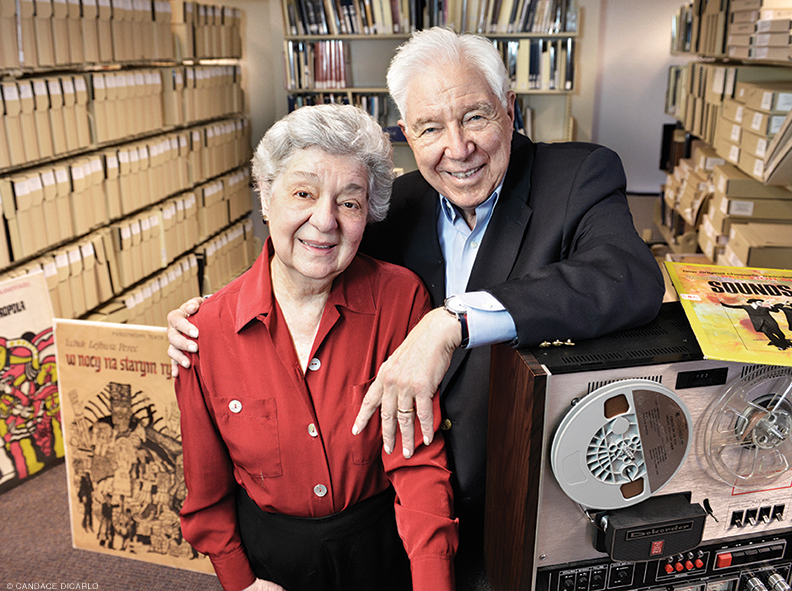
Carefully, he puts the record back, tucking it among the more than 1,500 separate LPs, 33s and 78s, tapes and compact discs that line one wall of his Center City condominium.
The Freedmans didn’t really set out to build one of the largest libraries of Yiddish music in the world, an international resource for scholars and musicians, one of a very few institutions devoted to an endangered, thousand- year-old culture.
But that’s what they’ve done. What began as a hobby has evolved into a cultural shrine, a magnet for students of a world that has now almost completely disappeared. Collected over 30 years in record stores and second- hand shops from Moscow to Buenos Aires, the Freedmans’ trove of Yiddish folk songs, art songs, theater music, novelty hits, klezmer music and more, is said by scholars to be the largest in private hands in America.
Filling parts of two adjacent apartments they own overlooking Rittenhouse Square are recordings from North and South America, Europe, Russia, Israel – every place Yiddish has been blown by the social hurricanes of the last century.
Seated in the Freedmans’ formal French living room, you hear vaudevillians and Hasidim, borscht-belt clowns and Holocaust martyrs, sweatshop poets and cabaret queens. Among the LPs, cassettes and CDs are liturgies and drinking songs, torch ballads and camp tunes, socialist hymns and more, performed in an endless range of musical styles.
Some songs crossed over and became ”American:” Benny Goodman’s swing tune ”And the Angels Sing,” which started life as a Jewish-Greek dance tune called ”Shtiler Bulgar”; or the lament ”Der Milners Trern” (”The Miller’s Tears”) whose melody ended up in the film High Noon.
Some went the other way, a Yiddish version of Gilbert & Sullivan’s ”HMS Pinafore.” And some of them went both ways, including a bilingual ”When the Saints Go Marching In” (”Ven di Tsadikim Kumen On”).
But what makes this more than just a big bunch of records – one couple’s obsession, good for impressing the guests and that’s that – is the Dell 386 computer sitting in the corner. For nearly 10 years, Bob Freedman has been indexing his collection here, punching some 17,000 separate entries into an English-Yiddish database that now occupies part of a 200-megabyte hard disk. With a few keystrokes, he can trace any song by title, composer, performer or subject matter, locate literary, geographic or Biblical references, or connect poems set to music with their original publications. And he can do it in either the Latin alphabet of English, with the cursor going left to right, or Yiddish, which uses Hebrew characters and goes right to left. An achievement even more impressive when you realize Freedman began his project in 1982, practically the Dark Ages in computer software terms.
”It was a problem,” he recalled, his tennis-trim body perched in a small desk chair. ”There weren’t any Yiddish fonts designed for computers.” An open-faced, white-haired man, Freedman has only a passing ability to read and speak Yiddish, and was even less expert in computerish. But a friend who was an electronic maven helped him ”burn” a microchip on a 64K Franklin Ace computer – in effect, got him under the hood of his machine – to hot-wire what may have been the world’s first Yiddish word-processor.
Two computers, three software upgrades and 18 megabytes later, Freedman has a 3-inch-thick catalog and a growing reputation in Yiddishist circles that has kept scholars and students coming to his door.
”The collection is simultaneously priceless and worthless,” says Henry Sapoznik, a musician and archivist who directs the sound library at New York’s YIVO Institute, the largest Yiddish library in the world. ”There is no market for what he has collected. But its value transcends what you can pull out of your pocket.
”Yiddish music is a map, a historical map of where Jews have been. It tells you how comfortable they’ve been in the cultures where they lived.” Yet for most modern Jews, the repertoire remains something exotic, practically unknown. ”There are just wonderful old recordings that still have the power to transfix listeners,” Sapoznik says. ”There’s a whole cadre of singers who are really amazing, and simply because they sing in Yiddish, they’ve been ghettoized.”
THERE WAS A TIME, BACK BEFORE WORLD WAR II, and Israel, and suburbs, when such music spilled out of windows in parts of South and West Philadelphia, Logan, Oak Lane or the Northeast. Yiddish, the 1,000-year-old language of Ashkenazic Jews, was still a living tongue, spoken by some 11 million people worldwide and a vital medium for journalism, scholarship, theater and music. Not just Miami Beach bubbes and Catskills comics, but Warsaw factory workers and Vilna intellectuals, Montreal cabbies and Argentine farmers, Johannesburg diamond merchants and Chicago union organizers spoke, thought and sang in Yiddish.
In Philadelphia, as in every other major U.S. city, Yiddish actors and musicians had attracted wide audiences since the 1880s, when millions of Jewish immigrants began fleeing poverty and oppression in Eastern Europe. With the introduction of radios and phonographs, Yiddish performers capitalized on the folk and popular music traditions to record and broadcast as well.
”My mother had a lovely voice and still does,” said Molly Freedman, a handsome, energetic woman who grew up over her parents’ West Philadelphia grocery. ”She used to sing all the time, so I just heard all these songs around the house. And my father loved to play his recorded 78s.” Especially Belarsky. ”He was the singer of the period – my father used to play his stuff every Sunday. In the Italian houses they played Caruso; in my house they played Sidor Belarsky.”
In 1958, she met a young law student from Upper Darby who shared her love of music. Like her own, Bob Freedman’s parents were small shopkeepers, not particularly religious, but people who nonetheless had brought to America a political culture that combined socialist idealism with a traditional, homespun Yiddishkeit.
”I came from this very politicized background, very ideological,” Bob remembers. ”I thought everybody had an ideology, and that everybody was left.” It wasn’t the leftism that stuck with him, however. ”When my parents and their friends got together, they were a very alive, vibrant group. Every gathering had a purpose. And whenever they would get together, they would always sing.”
The Jewish left in those years was split among a half-dozen subgroups, including pro-Soviets and anti-Soviets, anarchists and Zionists. Most spoke and supported Yiddish, the language of the Jewish masses. Philadelphia alone supported four separate Yiddish school systems. Each was a network of afternoon academies in the larger Jewish neighborhoods where children studied language, history and culture after their regular public school day had ended. And each had its own political agenda.
Freedman’s father, a clothing shop owner, was a Labor-Zionist. Five afternoons a week, Bob took a bus and a trolley to Yiddish and Hebrew classes on Larchwood Avenue in West Philly. Summers he went to a Labor-Zionist camp upstate, absorbing ideology and Yiddish songs in between baseball and camp- outs. Molly did the same, but her camps had a different ideological bent, so she learned different songs. If you get them started, they can still get into a nice argument over which songs went with which faction.
By 1958, however, neither Jewish-left politics nor Yiddish culture was thriving. Hitler had wiped out most of Yiddish-speaking Eastern Europe, and the Soviets were suppressing most of the rest. And although millions of Yiddish-speaking Jews found refuge in Israel, their language did not; Hebrew had been designated the tongue of the new Jewish nation, and Yiddish was systematically – even sometimes violently – discouraged.
American Jews, who had been discarding the language of their parents and grandparents as they moved into the middle class anyway, were encouraged to do so further by a synagogue-based establishment that took its cue from Israel. Teaching children Yiddish seemed increasingly pointless.
There were, however, a few holdouts, including two dark-haired kids from Philadelphia, who had run across each other at a party and started to date. ”In the summer of 1958, most people in our crowd were hanging out at Atlantic City on the boardwalk,” Molly recalls. ”So Bob and I used to go out to Margate, to a spot where it was quiet, and we’d sit on a bench and sing these songs to each other.”
They traded lyrics. She put words to his music, and he to hers. Soon they married. ”My dowry consisted of seven Sidor Belarsky records,” Molly said. ”And they were all worn out, because my father played them constantly.”
Cut to 1979. The Freedmans, now of Elkins Park, he a prosperous real-estate lawyer, she a mother of two and a part-time Temple student, pull up to 30th Street Station in their car. Two out-of-town college types, researching Yiddish music, had heard about this private collection in Philadelphia and asked to come down. Sure, come, Bob and Molly had said. Stay the weekend. Outside the station, sitting on backpacks, were Henry Sapoznik and Marty Schwartz, two skinny, long-haired guys who looked like refugees from Woodstock. Which, in a way, they were.
”That was actually pretty funny,” Sapoznik remembers today. ”(Bob) looked like he thought he was on Candid Camera. ‘What is this? Who’s putting me on?’. . .The whole klezmer thing had just begun, so there was no real precedent for people their children’s age being not only interested but enthusiastic about this music.”
An anthropologist might call it a moment of cultural transmission. Sapoznik and Schwartz, a professor of Near Eastern languages at Berkeley, were pioneers in the revival of klezmer, the music of itinerant Jewish wedding bands in Eastern Europe. Like Yiddish itself, the music had blossomed as Jews left their Polish and Russian shtetls for the cities and America in the 19th century. It flourished briefly here in the 1910s and 1920s before assimilating into American jazz and pop, leaving few traces – a few hundred bad accordionists playing ”Hava Nagila” at weddings and bar mitzvahs.
But in the mid-70s, young American musicians coming out of the folk and rock worlds rediscovered klezmer’s older, wilder spirit, and began experimenting with their own re-creations.
”I had just begun the year or two before, doing my own research into popular Yiddish music at the turn of the century,” Sapoznik said recently. ”I don’t now remember who told me about Freedman – it’s such a small universe of people who are interested in this stuff. . . . Anyway, the visit was sort of epiphanal for us both. He was collecting LPs, and doing an incredible job of documenting them. It was sort of like King Tut’s tomb.”
Schwartz stayed a week, during which he and the Freedmans combed second- hand shops in Philadelphia’s older ethnic enclaves. They struck gold at an ancient junk shop on Kater Street, owned by an elderly man named Dorfman. After some intense negotiations, Bob ended up on a ladder, dressed in tennis whites amid the dust and mold of decades, pulling old records from shelves. ”He found one that had a chunk missing – it looked like somebody had taken a bite out of it,” Molly said. ”And when Bob held it up, Dorfman yelled, ‘It’s still got three good songs on it!’ He had saved everything.”
Sapoznik today leads a successful and innovative klezmer band called Kapelye; Schwartz has produced collections of classic klezmer recordings and played mentor to West Coast bands, many of whose recordings Bob and Molly have dutifully added to their collection.
Others have used the Freedman archive to unlock more specific and esoteric bits of Jewish history. Ellen Prince is a Penn linguistics professor, one of a tiny group of academics who have used Yiddish to examine wider theories of dialect and grammatical structure. In 1982 she stumbled across an old Yiddish tape by an operatic singer named Sarah Gorby. Prince noticed that Gorby sang in a dialect peculiar to Romanian Jews, which was almost never used by performers outside that region.
”I became obsessed with this Yiddish singer,” Prince said. ”She had a beautiful contralto, and the songs were magnificent, only I hardly understood a word.” A self-described partisan of regional speech who clings tenaciously to her own Brooklynese, Prince determined to learn more.
”I wrote to Columbia records, since they’re supposed to have a master list of everything ever recorded. They wrote back: ‘This singer never made another recording.’ Then I met Bob Freedman. He had six of them.”
The discovery launched an investigation that took Prince to Argentina, Europe and Israel. Gorby, she discovered, had been a kind of feminist maverick, breaking convention and giving up a marriage for the sake of her singing career. In the 1930s and 40s, she performed classical opera and art songs throughout Europe and North and South America, living through the Holocaust years in Haiti before eventually settling in Paris. There she drifted back to a predominantly Yiddish repertoire and won a loyal following but no financial success before dying, broke, in 1980. ”Until the day she died she would jam with Gypsy musicians in Paris,” Prince said.
In 1987 Prince published two linguistics papers based on her study of Gorby’s language, and a piece on Gorby’s life in the Forward, the last of the old Yiddish dailies still publishing. She also added several tapes and records to the Freedman’s collection.
NOBODY’S KIDDING THEMSELVES; the new interest in Yiddish shown by a few academics and ethno-folk music fans hardly constitutes a revival. As Jack Kugelmass, a cultural anthropologist at the University of Wisconsin, notes: ”No language can survive without a social base. Yiddish itself will not revive as a major spoken language among large numbers of Jews.”
Still, people like Sapoznik, Prince and the Freedmans are giving Yiddish a measure of respect the language has not historically enjoyed. For centuries it was looked down on by Jews and non-Jews alike as jargon, a bastardized mishmash of German and Hebrew. It was the mame loshen, the mother’s tongue, the common language of the uneducated, women and children.
In fact, Yiddish’s pedigree is the equal of most modern European languages. The oldest known written sample dates from the 11th century. Yiddish grew out of medieval German, just like English, and borrowed pieces from other languages, just as English still does.
But Yiddish always suffered in status alongside Hebrew, the language of the Bible and of Jewish scholarship since ancient times. Jewish men traditionally learned Yiddish at home and Hebrew at school. And when they finally broke out of the European ghettos, they quickly adopted the predominant languages of their fellow citizens.
As it slowly fades, Yiddish, a language that specializes in irony, may now be going through one of the most ironic shifts in history. Of the estimated 500,000 active Yiddish speakers left in the world today, an increasing proportion are ultra-Orthodox or Hasidic Jews who use it regularly in religious study. Many of the rest are linguists, historians, or folklorists. Hebrew, meanwhile, is spoken by three million Israelis, the secular, daily language of cab drivers, merchants and politicians.
But the tricks of history don’t particularly concern the Freedmans, who appear to be simply delighted to have and share the music they love.
”You want to preserve happy memories, and I associate the music with happy memories,” Bob said. ”I associate it with holidays, with friends, with youth. We could have a very learned discourse on preserving the culture. There’s a facet of that, but I think it’s part of everything else.”
With that, he sets up another recording, perhaps his favorite. A Yiddish translation of a poem by the Indian writer Rabindranath Tagore, set to a surprisingly un-mournful tune.
   Far vos iz dos likhtele farloshn . . .
    (Why did the flame go out?)
   Far vos iz dos blimele farvyanet . . .
    (Why did the flower fade?)
   Far vos iz di strune tserisn?
    (Why did the string break)
   Ikh hob zi getsoygn, alts hecher un shtarker gevolt zi zol shpiln . . .
    (I stretched it tauter; I wanted the music to soar higher and stronger.)
 ACassel's Pages